
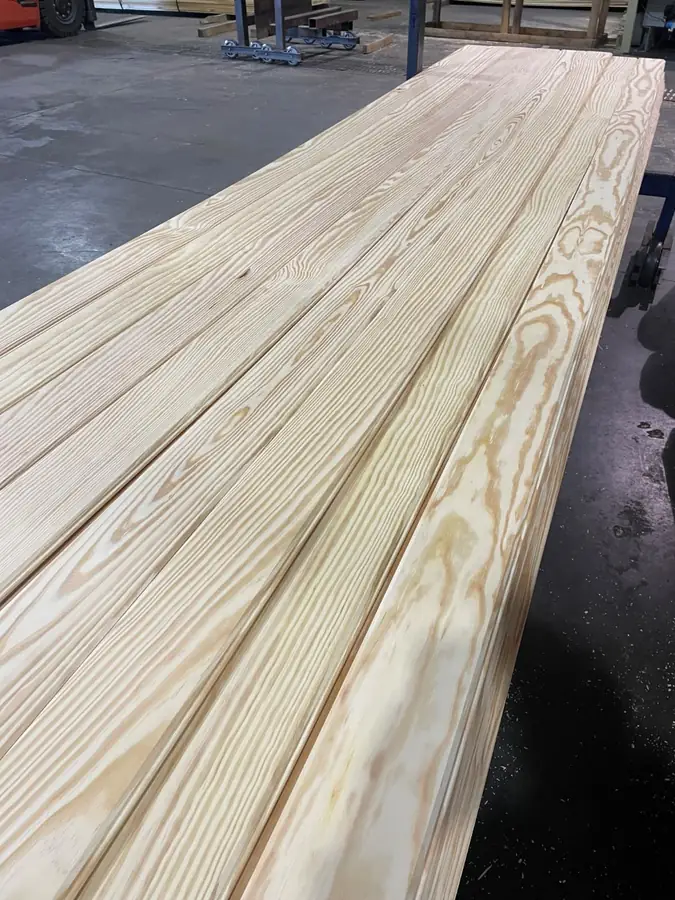
Southern Yellow Pine
Our standard stock and the workhorse behind most of the tongue & groove, V-joint, and shiplap that leaves the mill.
What Southern Yellow Pine is
Southern Yellow Pine is the group of fast-growing pines that built the South — longleaf, loblolly, slash, and shortleaf. It grows within a truck ride of the mill, which is a big part of why it prices the way it does and why we can keep grade and thickness consistent from one order to the next.
It is a dense softwood. Pound for pound it is stiffer and harder than most other softwoods in its class, with a pronounced grain pattern that runs amber to honey and darkens warmly with age. That grain is the reason a knotty pine ceiling reads as wood rather than as paneling.
Because the growth rings are strong and tight, pine machines crisply. Tongues stay square, grooves stay clean, and a V-joint chamfer holds its edge instead of fuzzing — which matters most on the profile whose entire point is a fine shadow line.
How it behaves in a Florida house
Pine moves with humidity like every wood does, so give it a few days on site before you hang it. Stack it loose in the room it will live in, let it come to the moisture content of that space, and the joints will stay tight through the first dry winter instead of opening a hairline gap at every seam.
Kiln-dried pine on a conditioned interior is stable and predictable. On a covered porch or a pavilion ceiling it does fine with a sealed finish on all faces — that is thousands of square feet of what we ship every year. Where pine is not the answer is unprotected exterior work in direct weather; that is a cypress job.
Stain, paint, and how the color ages
Pine takes stain beautifully but it takes it unevenly if you skip prep. The soft earlywood drinks more than the dense latewood, so a wiping stain straight onto raw pine can blotch. A pre-stain conditioner or a thinned first coat evens it out and gets you the finish people picture when they say stained pine ceiling.
Under paint it is excellent — prime the knots so tannin does not bleed through, and a sprayed finish lays down flat. Clear-coated pine ambers over the years, which most people like; if you want it to stay pale, a whitewash or a UV-resistant clear slows it down.
Best uses for southern yellow pine
Ceilings, flat and vaulted
The most common thing we mill pine for. Cost per square foot lets you carry boards across a whole great room instead of stopping at an accent.
Interior walls and accent walls
Shiplap and V-joint in pine, painted or clear-finished, is the default spec on farmhouse and coastal interiors around Ocala.
Barns, stalls, and shop walls
#2 grade pine takes abuse, the knots look right in an ag building, and replacing a damaged board is cheap and easy.
Covered porch and pavilion ceilings
Fully sealed pine handles a covered outdoor ceiling well and is the value pick when the boards never catch direct rain.
Where we would steer you somewhere else
- Unprotected exterior siding or trim in direct weather without a maintained paint film
- Ground contact or anywhere the boards stay damp
- Absolutely flat, grain-free painted faces — poplar is the better call there
Stock and lead time
- Standard stock in 1x6 and 1x8, #2 and clear grade, in every profile we mill.
- Standard lengths are 12 and 16 ft, with 4, 8, and 10 ft available on request.
- Whole-room and whole-house packages usually pull straight from inventory — no lead time on typical orders.
Call (352) 895-9950 with your square footage and we will confirm what is on the ground before you plan the job.
Which grade to order
- Number 2 Grade
Sound knots and natural color variation. The value pick for barns, shops, rustic ceilings, cabin walls, and anything getting a heavy stain or a painted finish.
- Clear Grade
Minimal knots and straighter grain. Use it where the wood is the finish — great rooms, entryways, and stain-grade trim work people stand two feet from.
How to finish it
- Condition before wiping stain to avoid blotching on the soft grain.
- Prime knots with a stain-blocking primer before painting.
- Seal all six faces on porch and pavilion work, including the tongue and the back.
Milled in southern yellow pine
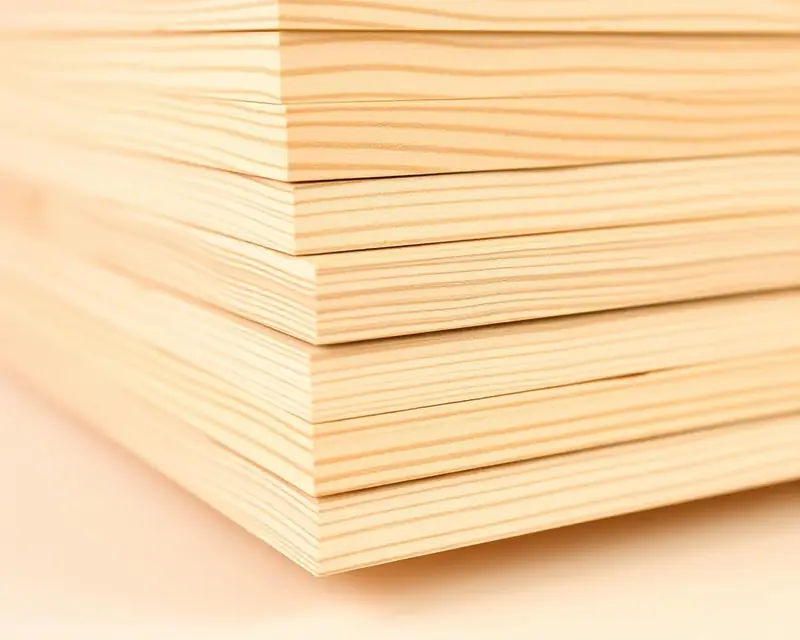
A milled tongue on one edge and a matching groove on the other, so boards lock together and hide every fastener.
View Tongue & Groove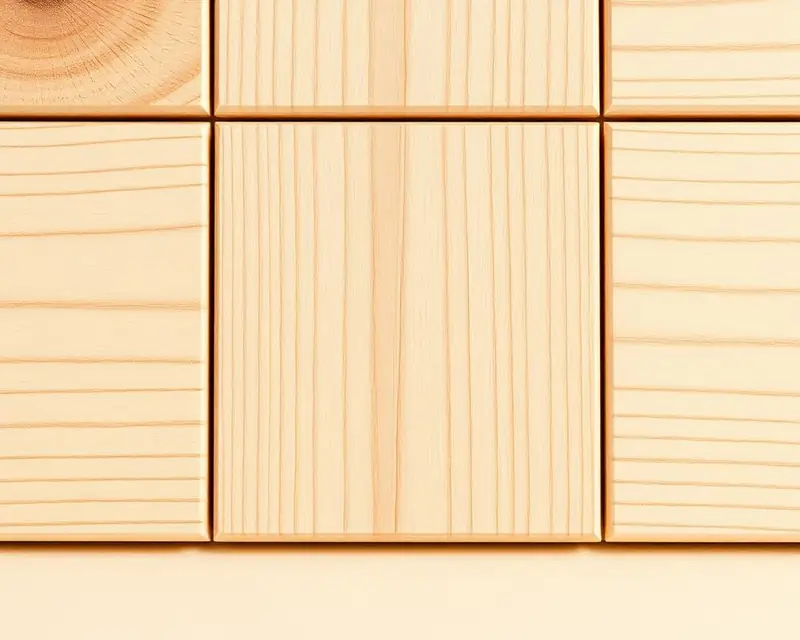
The same locking tongue and groove joint with a chamfer milled on each edge, giving a crisp V-shaped shadow line at every seam.
View V-Joint
An L-shaped rabbet cut into each long edge so boards lap over one another and sit flat, leaving an even reveal at every joint.
View Shiplap SidingOther species we mill
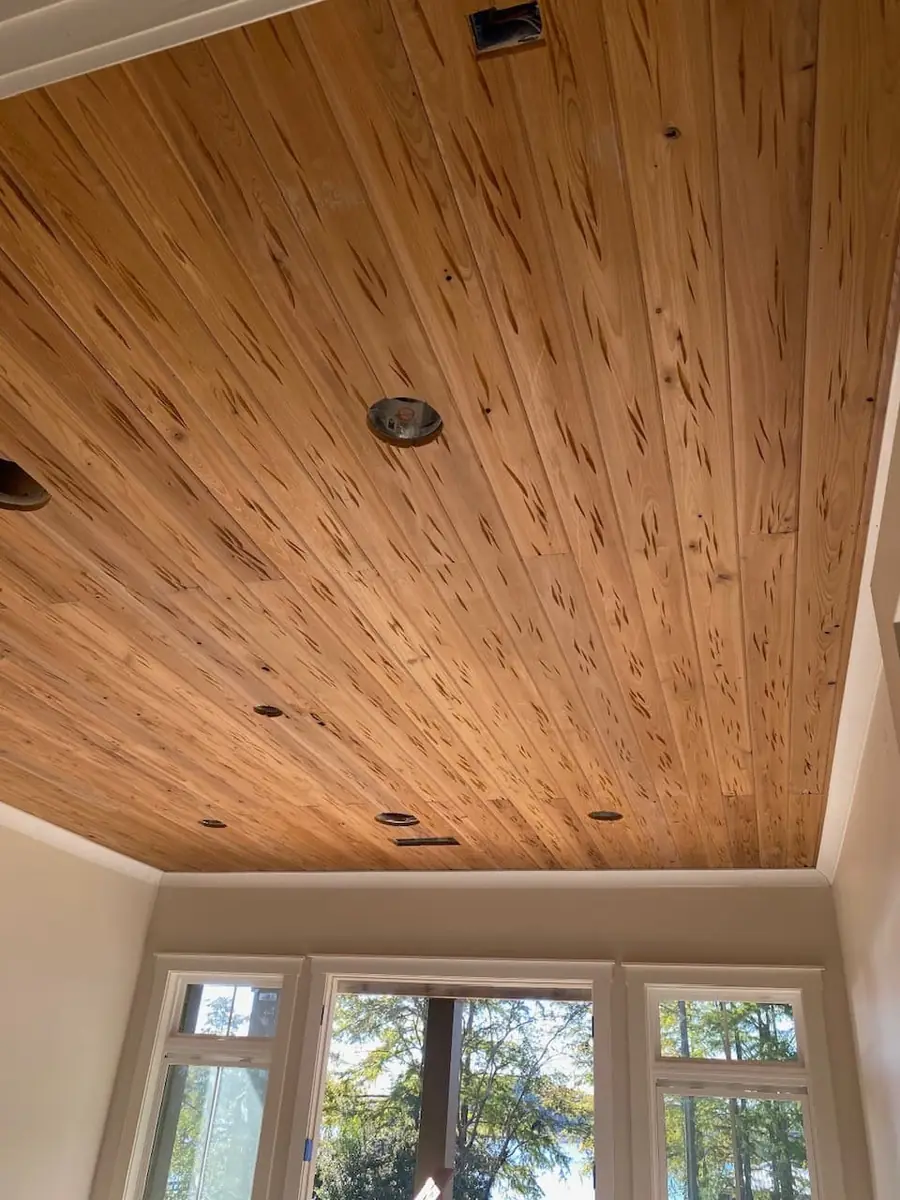
Thinking southern yellow pine?
Tell us the room, the square footage, and the finish you are after. We will tell you straight whether this is the right species for the job.
Locally yours — Ocala, FL.